Showing posts with label zen. Show all posts

Thursday, May 12, 2016

Karate as Dynamic Zen

My own background in training lies for the most part in Shotokan karate (supplemented heavily with Bruce Lee's Jeet Kune Do, Filipino kali and Rickson Gracie Jiu Jitsu). Like most people starting out I was primarily interested in learning how to take care of myself in a fight while also being heavily influenced by the romantic images of Okinawa portrayed in the movie The Karate Kid II which was a very popular movie that played a huge part in inspiring me to head to my local dojo. This was not my earliest experience with Japanese culture but it was the decisive one and through its influence I have been living in Japan for the last 18 years.

I am heavily influenced by the philosophy of the Zen monk Takuan Soho and his work in The Unfettered Mind and have traced the transmission of this teaching through the last four centuries. As a result of this I take a concepts-first approach to my practice of karate and seek to uncover ever more obscure points that govern the execution of form, or technique.

I first explored this some 20 years or so ago publishing an article entitled The Concept of Shotokan Karate (now available on Amazon Kindle) but since then my investigation of the relationship between Zen and martial arts has gone deeper than I originally thought would perhaps be possible. As a result of this I will also be exploring how it is that a chosen combative art form can lead a practitioner to experience a state of "satori", or realization (often popularly described as enlightenment, though I prefer to avoid that term).

Karate as Dynamic Zen

In my early training and research I became exposed to various Eastern spiritual traditions, especially Indian Buddhism, Chinese Daoism and, of course, Japanese Zen Buddhism. I was immediately attracted to the idea of viewing karate as a kind of moving Zen (what I now call a dynamic form of meditation) and delved into various books and articles eventually coming across the biography of Yamaoka Tesshu and the translation of The Unfettered Mind by Takuan Soho. These texts have absorbed a huge amount of my time and attention now for more than 20 years and my research has expanded into fields such as neuro-science, history, archaeology, psychology, mythology and comparative religion to name the primary areas of my current interest.

Starting with the question - from an academic point of view - as to how a martial art (Shotokan karate in my case) can lead a practitioner to an experience of satori my research has led me to the tentative thesis that what is happening at the time of spiritual realization is a sudden, but absolute, shift in brain dominance from the controlling left brain hemisphere to the right brain hemisphere (subordinate to the left hemisphere for most of us during our waking hours). In this way we let go (completely) of our sense of linear time, of notions of self and other, of here and there, of now, then and later, all characteristics of how the left brain hemisphere understands and represents the world, and replace these usually-dominant thoughts with the sense that there are no divisions and no limitations.

Even more tentatively, I am absorbed with the idea that for a few millions of years the default pre-human and human condition was to be right brain hemisphere dominant and that our shift to left brain dominance has occurred relatively recently, perhaps by a severe change in diet, and reinforced by the creation of the spoken language and reading and writing (which were themselves made possible by the theorized shift in brain dominance). This, I hypothesize, is the Original Mind of pure consciousness, free of defilement and the conceptual world.

At first blush these questions may seem alien to the practice of a martial art, but I believe that extended practice of some combative form or another is a reflection of an ever-progressive quest to satisfy ever deeper needs, somewhat akin to Maslow`s hierarchy of needs. Often at the most fundamental level a martial system is required to satisfy the need to be able to fight. That is, after all, what separates a combative art from other activities. Some people may be happy to learn a few techniques and feel a little safer and quit training. Others, their need for at least rudimentary fighting skills now satisfied, continue to attend their dojo. These people are looking for other needs to be satisfied...the need to be fit and healthy, a social need, a need for a sense of accomplishment, a need for competition, if not with other people, then at least with oneself. And so it goes on. I had a need as a teenager for exposure to something that to me at the time was exotic hence the appeal of Karate Kid II and my desire to travel to East Asia. As we progress we may view our chosen art as exactly that: an art form that fulfills our need to express ourselves while also being a vehicle to investigate ourselves. Finally though I believe that a martial art can sate our need to understand the whole process of existence, of living and dying.

Thus our chosen martial art - whether it be karate or some other form - becomes a way of life: a lifelong pursuit to understand - and express - life through the practice of a combative art form.

Sunday, June 17, 2012

Personal Development

What is Personal Development?

PD can be understood as developing the self and / or developing others. Its mainstream techniques include setting goals, developing plans useful in achieving those goals and then taking action in pursuit of those same goals. Typically goals are set in areas such as health and fitness, personal finances, relationships, careers, spiritual beliefs and overall life satisfaction.

Why is Personal Development Important?

Broadly I identify two approaches to personal development: curative and preventative. From a wide reading of personal development literature I would say that much of the PD field is curative; that is, the techniques and philosophies seek to cure a pre-existing problem. For example, perhaps someone is already over-weight, in which case a plan is presented detailing various actions to be taken in pursuit of the realization of the goal of weight loss. Another example might be with someone who is in credit card debt. Here a step-by-step plan on paying back that debt will be laid out and the borrower will take action based on that plan, aiming to remove all debt from his life. In both these cases the techniques presented are curative; they are reactions to an established problem that they seek to ‘cure’.

While such approaches may be useful and even necessary for some, by far the method of personal development that I prefer is what I label preventative. Preventative personal development means that you pursue a life course that minimizes and even removes the risk of getting yourself into an undesirable situation in the first place. For example, rather than gain weight and then set about losing it, preventative personal development teaches skills and knowledge designed to ensure you never become over-weight in the first place. Similarly with credit card debt: by disciplining yourself and your spending at the outset, you intend to never find yourself in a situation where you owe money on a credit card, as an example, looking at 15-20% interest repayments.

In terms more immediately understandable to martial artists, it is the difference between avoiding going to high risk areas where a fight is more likely to break out (the preventative approach) as compared to getting into combat and having to use your art to fight your way out (the curative approach).

Two outstanding examples of mentors that I identify as teaching the preventative approach to personal development are the late Jim Rohn and Denis Waitley. Jim Rohn’s (paraphrased) exhortation to ‘build on rock, not sand’ should never be forgotten. Similarly, Denis Waitley talks about (among other things) taking a proactive approach to your health, rather than waiting until your bodily systems are beginning to fail before taking action. This of course is a central point to Asian medicine which tends emphasize prevention rather than curing.

Preventative personal development then is important in ensuring your quality of life from the outset by pre-empting and pre-solving problems and issues that would otherwise be detrimental to you and your lifestyle.

How Does Personal Development Relate to Martial Arts?

At first the link between martial arts and personal development may seem tenuous at best. Martial arts appear to be about fighting and preparing for a fight, whereas personal development focuses on, among other things, the creation of wealth, happiness and contentment. My own understanding of martial arts, and the method by which I practice and teach, runs deeper than this however. Sure, martial arts appear to be about fighting but, I would argue, if that is all they are about then you are most likely wasting your time studying them. How many fights have you been in since you left Junior High? How many fights have you even seen since you left Junior High? I’m not saying violence can’t rear its ugly head at unexpected moments, and we should certainly be prepared for such an eventuality, but to spend hours of your week preparing for a fight that in all likelihood is never going to happen is not an efficient use of your time and energy. What I am interested in, and what my life philosophy of The Way of the Enlightened Zen Warrior is about, is applying knowledge and concepts that you learn in the pursuit of your art to the wider context of your life. Karate do is, afterall, a way of life. An obvious example of this is related to your health and fitness. Martial arts of all styles provide an excellent method of keeping fit and setting high personal standards, as long as you don’t overdo it and over train and / or pick up an injury. What is more useful to you on a daily basis: your health and fitness or your ability to fight? A further question for you to ponder: would you consider extreme, ‘realistic’ training that leaves you injured in preparation for a possible street fight worthwhile?

I want to emphasize that I am not advocating that the fighting aspect of the arts be disregarded. Far from it. I sincerely believe that it is the combative dimension of the warrior arts that keeps us realistic. Funakoshi sensei asked us to part the clouds, not live with our heads in the clouds. But being realistic means being realistic. So again, I would ask you to consider: realistically, what has more value to you: your health and fitness or your fighting ability?

I can provide some more concrete examples to demonstrate my point with, to take two, time management and making money. Martial arts techniques, or at least those inherited from the battlefield, are efficient. They had to be and they still have to be. Any inefficiency could lead to a violent death. Efficiency then is a concept that can be applied to other aspects of our lives, one such being time management. A lot of people have problems with time management, but what is effective time management if not the efficient use of time?

Turning to making money: anyone who has ever invested money or traded on the stock market or the Forex market will know how important timing is to turning a profit. With proper timing your earnings can accelerate exponentially; but with poor timing you can quickly find your capital wiped out. Timing too is a vital component of every martial arts technique when thrown with the intention of connecting with an opponent. Timing is as important to throwing a punch and knocking someone out as it is to making a million. So again, ask yourself what is more useful to promoting a successful life: effective time management skills and the ability to make money or your prowess as a fighter?

This fundamental observation on what skills and concepts grant us the highest return for the energy and effort we put into their investigation and development is also supported by my research into spiritualism and ‘enlightenment’. I define satori (‘enlightenment’) as being a moment of complete right hemisphere brain dominance, following my reading of two people in particular: Dr Julian Jaynes and Tony Wright.

While I an open to the suggestion both men make that the human species is caught up in a dynamic shift in brain dominance from the right hemisphere to the left hemisphere, I also recognize that we all live in a world that has been created by and for people who are left hemisphere dominant. It doesn’t matter how ‘enlightened’ you are, you still need to get up every morning and live your life...and living that life includes interacting with other people, looking after yourself, and making money as well as understanding some overriding spiritual meaning to it all.

It is here that personal development really becomes a useful tool to us: it helps us improve the quality of our lives and that of those around us. It is firmly rooted in the conceptual world and recognizes that that world is complicated and that we must satisfy different needs to experience our own individual sense of happiness in contrast to the conditions our right hemisphere wants met to realize its own (different) form of bliss. For example, our right hemisphere enjoys artistic stimulation (among other things) and being able to sit quietly and listen to some good music is one way of satisfying this desire. At the same time, in order for us to be able to buy a CD player or download a song we need to be able to engage our left hemisphere. The process through which we achieve this purchase is a long and complicated one; much more complicated in fact than you might first think when you take your time to consider in detail all the multitude of different things that have to happen for you to be able to go shopping or go online for a download. To be able to comfortably afford a CD we need to have a job that provides us with an excess of income…to get that job the usual route is to get good grades at school leading to professional qualifications…and so on. In these activities the left hemisphere is primarily engaged and for many of us we feel happy through a sense of achievement (getting good grades, a good job and earning good money) while interacting in a meaningful way with the people around us. Personal development is much more geared towards this kind of satisfaction. It was created in the ‘real’ world for use in the real world. In other words, it deals with reality…and this takes me back to what I said earlier about the reality of combat.

Martial arts cannot and should not be divorced from reality. They are martial arts. I say this not only because of any over-riding need for effective fighting techniques but because a firm grasp of reality is necessary to live effectively in that reality. Martial arts teach us to view reality in a complete manner; from both the perspective of the left and right hemispheres. While our left hemisphere conceptualizes everything and our consciousness acts as a constant filter between what we perceive and how we perceive it, our right hemisphere, being non-conceptual, simply cannot conceptualize what it perceives and therefore experiences reality ‘as is’. Both perspectives are important and allow us to view reality holistically. This in turn takes us back to the underlying spiritual philosophy of many of our arts: Buddhism. Those of you familiar with the Noble Eightfold Path will know that it rests fundamentally on ‘Right View’; or seeing reality. Certainly in my teaching of The Way of the Enlightened Zen Warrior, this ability to view reality from both the left (the normal view of reality) and right (a supra-normal view of reality) hemispheres is of vital and fundamental importance.

So, to sum up: Personal development is relevant to the martial artist because it enhances his or her ability to deal with the conceptual world, or, to put it another way, to fearlessly confront and harmonize with the reality that the martial artist uncovers through the crucible of combat. Understanding the reality of combat is too limited; we need to understand reality in the broader sense. Martial arts provide us with a vehicle to access this broader reality by first confronting us with the reality of a fight and then encouraging us to apply that same conceptual understanding to different areas of life, away from combat.

Return to the top of Personal Development.

Saturday, June 9, 2012

Big Mind Big Heart

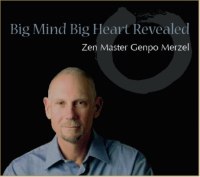
Big Mind Big Heart Book Review.

Given my interest in Zen Buddhism it is perhaps a little difficult for me to be truly objective about this book. This book is of direct interest to me and I have to say that I was blown away by it.

Merzel has dedicated most of his adult life to the pursuit and teaching of Zen and for much of that time he taught and practiced in a traditional manner. After being exposed to Voice Dialogue methodology by founders Hal and Sidra Stone, Merzel found his life and discipline moving in a new direction, the present sum of which is to be found in Big Mind Big Heart. Voice Dialogue is the practice of personalizing and talking to our different 'selves' to bring about the reintegration of 'lost' selves and create a harmonious balance and interplay between the different aspects of our psyche.

Merzel is specifically interested in accelerating the quest for satori (realization or ‘enlightenment’) and believes he has found a valid method through adapting Voice Dialogue specifically to his needs. Merzel attempts to bring about radical change and insight by talking to various aspects of a person’s greater self. These aspects include but are not limited to The Protector, The Controller, The Skeptic, Fear, The Damaged Self and continue through to The Dualistic Mind, The Mind that Seeks the Way, and Big Mind and Big Heart themselves.

The mock conversations (between Merzel and aspects of his own psyche) are fascinating and the reader can really gain an appreciation of how the Big Mind Big Heart approach can and does work. Much of the book is made up of these conversations and they clearly demonstrate how the mind can be moved towards satori. The book also includes a CD which is well worth listening to and gives you a taste of what a one-on-one session is like as Merzel leads a radio host in a Voice Dialogue session. The CD also includes a guided meditation designed to enhance the BMBH experience.

Whether or not the BMBH approach can duplicate the results of seated or dynamic mediation or not, I don’t know. I have to say I am doubtful that full satori can be experienced in this way. But it is nevertheless a very thought provoking and interesting read and I do think the techniques can prove useful to increase self-awareness and as a prelude to spiritual realization. Big Mind Big Heart will particularly appeal to followers of Zen and those interested in spiritualism and personal development in general. As for martial artists, I think the technique could easily be adapted to re-integrate 'lost' aspects of our psyche. A conversation with 'Fear' for example would prove immensely beneficial to anyone training in a fighting art.

Return to the top of Big Mind Big Heart.

Friday, June 8, 2012

Jesus, Mohammed and Zen

Jesus, Mohammed and Belief Contrasted with the Zen Method.

Recently I have been considering the origins of the differences between belief - based religions, such as Christianity and Islam, compared to the experience - based religions such as Buddhism and Gnosticism.

Broadly speaking I hold the opinion that both the Bible (specifically the New Testament as relating to Jesus) and the Quran describe, among other things, the personal spiritual experiences and insights of Jesus and Mohamed respectively...but that is all. I will state right now that I do not feel that either Jesus or Mohammed gained any spiritual insight the message of which is applicable to everyone else, nor do I think their experiences were one-of-a-kind and out of reach of an everyday person. That said, it is clear that both Jesus and Mohammed seemed to believe that their experiences were one-off, divinely inspired and that they represented the truth'. Or, at the very least, both men believed their spiritual insight was accurate enough to emphasize the message rather than the method. Both men have subsequently attracted large groups of worshippers. These believers hold the general opinion that both Jesus and / or Mohammed were some kind of intermediary between the secular and the divine. Jesus was promoted as the (literal) son of God while Mohammed is seen as a divinely inspired prophet. Their role was to conceptualize the truth of God and teach it to a wide audience who trusted that the divine missionary was indeed the ‘genuine article’. In this manner, there was no need for a believer to replicate the spiritual breakthrough both Jesus and Mohammed had and instead they have done and continue to be able to put their faith in divinely-inspired (as they see it) texts: the Bible and the Quran.

I would like to compare these belief-based religions to experience-based spiritual practices and to the Zen method in particular as it has the greatest relevance to practitioners of the Japanese martial arts in particular and is of central relevance to my teaching of The Way of the Enlightened Zen Warrior.

There are of course many interpretations of Buddhism but Zen in particular has maintained its distance successfully from any worship of person, idol or dogma for centuries, since its origins with the teaching of Bodhidharma and the mingling of Indian Buddhism with Chinese Taoism in the 5th century CE. It seems that Bodhidharma taught and practiced a method of 'wall gazing' which is not to be taken literally but instead refers to intense meditative practice and mental concentration. This amalgamation of Buddhism and Taoism came to be known as Ch'an in China, the forerunner of Zen. Ch'an in Japan became popular under the endorsement of the warrior class and took the name Zen. Zen means 'meditation'. Zen remains today a simple, if difficult and challenging, approach to having a ‘divine’ experience (satori, or realization). While pages and pages of writings remain with us and the corpus continues to be added to on a yearly basis by prodigious experts and laymen alike on the subject of Zen, those same authors are continually mindful in telling us not to confuse the written word with the truth. Zen remains at its core a method. There is no message as such. The Zen method – primarily the use of static meditation (zazen - seated meditation) and / or the solving of koan - has, over the centuries, remained an effective ‘finger pointing’. Both meditation and the use of a koan take you to where you want to go...neither is intended to be an end in themselves.

In essence the Zen method (though it is not the only way of achieving the same end) is concerned with granting enhanced right brain hemisphere access through quietening the left brain hemisphere, finally – or, more realistically, hopefully (no-one is saying this is easy…) – allowing the adept to grasp a moment of complete right hemisphere dominance (satori). My observations here stem from the reading of two people in particular: Julian Jaynes and Tony Wright. Julian Jaynes, in The Origin of Consciousness in the Breakdown of the Bicameral Mind, traces a shift from right hemisphere (non-conceptual and ‘divine’ experiences) to left hemisphere (conceptual experiences) over a period of several hundred years since writing in particular became more widespread. Tony Wright’s history of consciousness is far more sweeping and argues that this process – the shift from right hemisphere dominance to left hemisphere dominance – has been going on for millennia and continues today, hence our general inability to access the ‘divine’ and why the pursuit of satori is so demanding.

I hold the opinion that Buddha originally recognized this and developed a methodology to bring his students back into contact with the right hemisphere. Unfortunately this original teaching was watered down (requiring as it did so much work and the renunciation of much of the everyday world) but was perpetuated by Bodhidharma, blended with Chinese Taoism and is now maintained in the Zen method. Zen is concerned first and foremost with the attainment of satori or, to use modern scientific terms, complete right brain hemisphere dominance for a brief moment of time.

While this teaching has remained at the heart of Zen and should, I hope, be obvious to anyone with more than a passing in interest in this spiritual practice, I would like to present an argument that in fact this process – this method – lies at the heart of both Christianity and Islam and provides the insight for the message of both Jesus and Mohammed. This method however has been, if not lost, certainly de-emphasized and replaced with faith in the message of Jesus and Mohammed for their respective believers.

Before examining this point in greater detail, I would say that while anyone can experience greater (and even complete) right hemisphere contact and / or stimulation of the pineal gland (the third eye - where spiritual / religious visions arise from), everyone's right hemisphere and pineal gland are slightly different. So while everyone can experience a greater sense of 'spiritual' insight, that insight will always vary from person to person. The difficulty of conveying this difference in experience is then compounded with the limitations that we all have in attempting to describe something that is non-conceptual. By definition, right hemisphere contact is beyond description yet in order to convey a sense of this contact we are required to return to the left hemisphere (the seat of our linguistic ability) to satisfy our need for communication. Furthermore, everyone’s left hemisphere is also wired in slightly different ways, further inhibiting our ability to describe right hemisphere contact in a completely uniform manner. A good example of this that will be familiar to martial artists is Miyamoto Musashi’s Go Rin No Sho. Musashi rejects ‘Buddhism’ maintaining that his insight and teaching is beyond this limitation (see Introduction, paragraph 5 in Victor Harris's translation: ‘To write this book I did not use the Law of Buddha…’)...yet when push comes to shove he is forced to use distinctly Buddhist terminology to convey a sense of meaning. For example, the final chapter is sometimes translated as the Book of the Void, and at other times the Book of Emptiness, thereby betraying the distinct Buddhist influence through the use of Buddhist terminology. While I have no doubt that Musashi's satori was different to that of Buddha (or Jesus or Mohammed) it is clear that he is as stuck as everyone else in attempting to describe it and is forced to use familiar, Buddhist-inspired wording. Unfortunately, the use of a common lexicon can create the false impression that everyone is having the same spiritual experience when in fact they are not. Each experience may share common factors as the overall functioning of the right hemisphere remains the same for each of us, but the specifics will always vary. While everyone's fingerprints share certain similar characteristics, each finger print is nevertheless unique. It is the same with the make up and functioning of our brain hemispheres.

Daruma by Miyamoto Musahi

Daruma (Bodhidharma) was the Indian Buddhist monk who played a major part in bringing Buddhism to China. Once in China Buddhist principles mingled with Chinese Taoism and produced Ch'an, the forerunner of Japanese Zen.

Musashi, though not alone, was influenced by Zen Buddhist thought and terminology and was ultimately unable to express his great enlightenment without recourse to Buddhism.

So, moving onto an examination of Jesus and Mohammed...

I believe Jesus gained 'enlightenment' while meditating in the desert (The Temptation of Christ) as described in the gospels of Matthew, Mark and Luke. This event as described in the Bible has all the hallmarks of full right hemisphere contact combined with increased pineal activity (the visions of 'Satan'). We can assume that Jesus was fasting, deprived of sleep, meditating / praying / engaging in introspection, dehydrated, suffering extremes of climatic change, and living in a boring environment (no stimulation)...all the hallmarks of the conditions needed to effect a shift to right hemisphere activity.

The Temptation of Christ
Ary Scheffer

Mohamed similarly began meditating in isolation and away from the comforts of everyday life (such as they were in his day...). In the case of Mohammed, he retreated to a cave on Mount Hira near Mecca where he began to have spiritual experiences and we can assume again that he lived in a similar manner to Jesus in the desert: fasting, sleep deprivation, lack of stimulation and so on. Undergoing a similar experience as Jesus he seems to have also shifted to full right hemisphere dominance while also having visions (of the angel Gabriel) indicating the activation of his pineal gland (most likely the result of the stress both men experienced living as ascetics). This observation is further supported in the case of Mohammed by his reported propensity to suffer seizures which were also probably the result of extreme ascetic practice further strengthened by sudden shifts in electrical brain activity from the left hemisphere to the right hemisphere and back to the left.

The cave Hira in the mountain Jabal al-Nour where, according to Muslim beliefs, Mohammad received his first revelation.

Both Jesus and Mohammed then appear to have gained full right hemisphere brain access and both appear to have undergone severe spiritual training (termed shugyo in the Japanese traditions – austere training that goes beyond mere meditation). Both men then faced the problem that has plagued spiritual teachers over the centuries: how do I convey an understanding of my non-conceptual experience to others who have not had the same insight and live in a conceptual world? Predictably, and again, not for the first or last time, both men fell back on a lexicon that was familiar to them and created a message somewhat similar to but nevertheless different from what had been taught before.

But this is where a serious issue takes root and where we notice a divergence between teaching the method and teaching the message. Although not the first to do so, both Jesus and Mohammed chose to preach their message at the expense of the very clear spiritual method they used to gain their insight. Both men seemed to have believed that they had gained insight into a universal message that was the same for all men at all times. The result of this was the requirement that a follower simply listen to and believe in the message. There was no longer any requirement for a personal spiritual journey, and certainly not one as hard and demanding as the extreme and lonely ascetic practices undertaken by Jesus in the desert and Mohammed in his cave. The method was of no more importance; the message was prime.

Compare this to Zen. While Zen has a growing literature it never undermines or seeks to replace the method required to reach satori. This isn’t to say discussion is neither encouraged or beneficial, but endless theological musing can never succeed direct experience. The Zen teacher and the method of meditation and / or using a koan remain fingers pointing to the moon, or the hidden truth that lies buried in your right brain hemisphere.

While Zen employs a method of static meditation (zazen - seated meditation) the martial artist utilizes what I term in contrast dynamic meditation. Or, meditation in motion. Take a look again at what the ascetic disciplines of both Jesus and Mohammed entailed:

* Fasting
* Sleep deprivation
* Meditation
* Dehydration
* Climatic change
* Lack of stimulation

Those of you familiar with the likes of Morihei Ueshiba, Miyamoto Musashi and Yamaoka Tesshu will immediately recognize that these men – all men regarded as having had a profound satori - replicated many, if not all, of these conditions. Added to the list of what constitutes shugyo can be physical exhaustion and repetitive movement, both of which will be very familiar to any serious adherents of a martial discipline. All of these factors serve to tire and bore the left brain hemisphere and gradually force it into giving up conscious control of your consciousness...with the result being satori. This is a fundamental observation that informs my teaching of The Way of the Enlightened Zen Warrior.

Conclusion

I have argued that all people have the ability to gain full right brain hemisphere contact, leading to spiritual realization. This experience though varies in detail from person to person but each person in describing that event must rely on a lexicon that is inadequate. The result is that spiritual masters resort to reusing a limited selection of words constrained by their socio-historical context. The result of this is the apparent uniformity of experience where no uniformity in fact exists.

In the case of both Jesus and Mohammed these two great men, both of whom followed a prescribed course of ascetic discipline, gained full right brain hemisphere contact and subsequently described their insight using concepts familiar to themselves and others (a language predominantly inherited from the Jewish Old Testament in the case of Jesus and both the Old and New Testaments in the case of Mohammed).

However, once this description had been conceptualized it began to be taught and understood as 'the truth'. Both Jesus and Mohammed taught that understanding (and obeying) this truth in a conceptual manner was all that was required to assure entry into Paradise after death. Both teachers shifted their focus away from the method they used to gain spiritual realization and instead preached the message that adherence to the ascetic method had brought them.

This contrasts in a very fundamental manner to Zen. Zen over the centuries has continued to stress the importance of the method over the message, recognizing that the message will vary from person to person (and that the message will in fact be incorrect in any case given the impossibility of conveying a non-conceptual state using conceptual language).

I therefore conclude that Zen is a method leading the practitioner to his own inner truth while Christianity and Islam are messages leading believers to the conceptualized truth of Jesus and Mohammed respectively.

Return to the top of Jesus, Mohammed and Zen.

Sunday, June 3, 2012

Mushin

Mushin is one of four states of mind central to my teaching of The Way of the Enlightened Zen Warrior (the others being heijo shin, zanshin and satori) and it is an important concept in the Japanese martial arts and Zen. The term is most commonly translated as ‘no mind’ but I would like to examine in more detail exactly what this concept means to me and subsequently redefine it.

The first point is that I believe a more correct initial understanding is ‘no conscious mind’ rather than simply ‘no mind’. More specifically I am talking here about a decrease in the use of the left brain hemisphere and overall brain activity paving the way for a non-conceptual experience by allowing for greater and easier access to the right hemisphere of the brain (which is not conscious of itself). To put it another way, my initial presentation of my understanding of mushin is that it refers to the progressive disuse or quietening of the left hemisphere only (where our consciousness as we know it predominantly resides), rather than the mind as a whole.

Moving on, I do not see this concept as describing something that can be done habitually without the need for conscious thought. From reading various articles and books I have heard mushin used to describe how we do things without conscious thought or effort. For example, walking is something that we do without thinking. My experience though is that while we do not need to concentrate on walking that does not mean we enter a state of mushin. Rather, whereas a toddler learning to walk will be completely absorbed with developing the skill, although we don’t need anything like that level of concentration, we instead replace that mental focus the toddler displays with a focus of our thoughts on something else. In other words, we are still conscious; not of walking but of some other issue that captures our attention. For example, while walking we may be thinking ‘I need to move faster or I am going to be late’ or ‘Hmm, that looks like it’s a good restaurant. I’ll try it this weekend’ or ‘Should I stick with my current job or is it time to move on?’ Whatever we are conscious of while walking is immensely variable, from decisions about what to get for dinner to meditations on life, the Universe and everything. The point is that while we are not conscious of the mechanics of moving we have not quietened our minds. We are not in a state of mushin. We are still conscious of something.

The second point I want to make and what makes my understanding different to what else you will read is that I don’t see mushin as being a one-dimensional state. Rather, I see the experience of ‘no conscious mind’ as progressive and ever-deepening. Experts are able to record the electrical brain output through the use of an Electroencephalography (EEG) machine. Using this data our everyday, conscious mind is labeled as being in the Beta state. However, the Beta state describes a frequency of brain rhythm between 12-30 Hz. In other words, there is no simple ‘Beta’ brain state. We can be busy, stressed out and caught up in problem solving with a higher brain frequency (reaching up to 30 Hz) or we can be relaxing watching a movie (with a brain frequency lowering towards 12 Hz). In both states experts would label our brains as being at the Beta level of output, despite the very obvious differences in overall brain activity. This is important to note because the same observation applies to other brain states.

Taking an EEG reading.
The EEG apparatus is able to measure the electrical activity on the scalp of the subject, thereby indicating to what extent the brain is being used.

As we relax from the Beta state we enter the Alpha state. We reach this state when we are relaxed and we aren’t thinking of anything difficult or stressful. This is the initial state we enter into through meditation. However, just as the Beta state indicates a brain frequency between 12-30 Hz, so too does the Alpha state describe a band width of brain activity rather than a single level. Here the brain frequency is from 8-12 Hz. Beyond the Alpha state is Theta (4-7 Hz). What this data indicates is that there are deepening levels of meditation or, to relate the observations more directly to mushin, there are varying degrees of ‘no conscious mindedness’. Mushin is not therefore a fixed state that you are either in or you are not in. Two different people, I would argue, can experience two different levels of ‘no conscious mindedness’ or, the same person could have two different experiences of 'no conscious mindedness' at two different times at, say 8 Hz as compared to 4 Hz. I am sure that anyone who has meditated with any degree of success will attest to this. There are just times when you are able to go into a deeper meditation and, with practice, you become more able at entering a deeper Alpha state.

Ultimately the loss of consciousness, for as brief a moment as a second, results in satori, or 'enlightenment'. It is impossible for a functioning human to remain in a state of complete 'no conscious mindedness' as we would be literally unable to do anything, having no ability to conceptualize either ourselves or what is around us. In martial arts practice this is an important factor. If we ever attained full no conscious mindedness we would not perceive (an in conceptualize) an opponent's attack as being dangerous to us. Similarly we would be unable to formulate an appropriate response.

While in 'no conscious mindedness' you are better able to give free reign to your trained techniques depending on the stimulus provided by the opponent. I do not believe however that this is necessarily 'the best' approach to take to combat. To me, you are better off with an intense focus, or a state of zanshin. I will discuss zanshin more thoroughly at a later date but I will say that I believe the experience of mushin leads to, in the context of combat, a greater sense of zanshin.

Turning to the historical record to help clarify the term mushin, I detect that there is some historical misunderstanding here going back several centuries. Takuan Soho, the Zen monk who perhaps did more than anyone to marry Zen with the martial arts and create Warrior Zen, was nevertheless a monk and a non-combatant. His theories make for interesting reading but to me they lack the hands on experience of (deadly) combat.

Takuan Soho had this to say about mushin:

The mind must always be in the state of 'flowing,' for when it stops anywhere that means the flow is interrupted and it is this interruption that is injurious to the well-being of the mind. In the case of the swordsman, it means death. When the swordsman stands against his opponent, he is not to think of the opponent, nor of himself, nor of his enemy's sword movements. He just stands there with his sword which, forgetful of all technique, is ready only to follow the dictates of the subconscious. The man has effaced himself as the wielder of the sword. When he strikes, it is not the man but the sword in the hand of the man's subconscious that strikes.

I think this is an overly romantic portrayal of the mental state of the swordsman and does not reflect reality. I feel that Takuan Soho is selective in his choice of combat art to portray a Zen principle as the use of the sword will lead to, if done correctly, the very fast execution of the opponent. As I noted earlier though with the example of walking, over a prolonged period (which can be as 'prolonged' as a few seconds), our consciousness can shift away from the actual technique to focus on something else; but all the while we remain conscious. We have not entered a true state of no conscious mindedness.

Compare this to what Miyamoto Musashi writes on the technique of Munen Muso No Uchi To Iu Koto (On the Blow Free From Worldly Thoughts - the Spontaneous Blow) found in the Book of Water:

When both you and your opponent decided to strike simultaneously, both (1) adopt the position to strike his body, and (2) concentrate your will to strike. Accelerate your hand naturally and strike hard. This is called the munen muso ['free from worldly thoughts or no mind'] blow, and is a most important stroke. You will encounter it frequently. You must learn and practice it.

In Musashi's explanation it seems that the mind shifts from a state of 'no conscious mindedness' to one that is conscious of what it is doing and of the opponent, resulting in a 'concentrate[d]' hard strike performed at speed. This 'relaxed but conscious' mindset is reflected elsewhere in Go Rin No Sho, such as when Musashi writes 'Calm your mind, and do not cease the firmness for even a second' and 'Even when the body is at rest, do not relax your concentration'. Musashi appears to be talking about entering an Alpha state of consciousness but with the admonition to still be attentive - or conscious - of what is happening around you.

In conclusion then, rather than simply understand mushin as ‘no mind’ I therefore present a new definition and understanding: mushin is the progressive experience of deepening levels of no conscious mindedness.

Return to the top of Mushin.