Friday, May 6, 2016

Bassai Dai

Bassai Dai has a long history that is currently believed to stretch back some 400 years. On Okinawa the variations are called Passai. Funakoshi sensei made the name change when he brought karate to mainland Japan. It can be understood to mean 'To extract from a castle' or 'To remove an obstruction'. This refers it seems more to the spirit that should be displayed when performing the form rather than giving a clue as to the origins of the movements.

The pattern appears to have come to Funakoshi via 'Bushi' Matsumura to Kokan Oyadomari and then to 'Anko' Itosu, one of Funakoshi's primary teachers. All of these instructors created their own versions and how much the form resembles its original form is impossible to say. Different 'streams' of the kata continue to exist and have always done so. One movement that has remained is the opening stance where the left hand is placed over the right closed fist - indicating its Chinese origin. The form may have originated from Leopard and / or Lion boxing or possible Five Element Fist. There is no conclusive evidence available.

The Matsumura version shows the Chinese influence while the Oyadomari version has been altered, and this variation was in turn changed by Itosu and Funakoshi. It was Itosu who is believed to have created the 'sho' variation and Funakoshi taught both the 'dai' and the 'sho' version on mainland Japan. There are differences in performance between the Shotokan, Wado ryu and Shito ryu versions found on mainland Japan but when comparing the newer Japanese versions to the older Okinawan kata there are numerous differences, though the basic pattern of movement can be discerned.

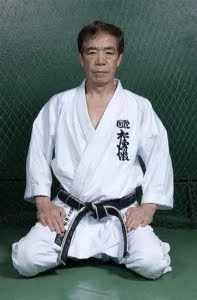
Master Kanazawa performing Bassai Dai

Thursday, May 5, 2016

Tekki Sandan

Tekki Sandan is the third in the Tekki series (see also Shodan and Nidan). While most, if not all, Shotokan dojo teach this kata as a ballistic one using strikes and blocks, Nathan Johnson, in keeping with his theory that the Tekki series in their original form were a catalog of wrist grip escapes and reversals, draws attention to the use of the Naifuanchin Fist Clench in three of his books (Zen Shaolin Karate, Barefoot Zen and The Great Karate Myth). This is a fist used in Chinese kung fu styles and is still seen today in some schools of Okinawan Shorin ryu. The fist is clenched with the bottom three fingers in the normal manner. The forefinger however is flattened out with the tip approaching the thumb joint and the thumb itself wrapping over the forefinger as normal. According to Johnson this grip was used to train and strengthen the hand for grappling. This fist can be seen on page 17 of Karate Do Kyohan by Funakoshi Gichin. However, Funakoshi sensei does not note that the fist is used to practice developing a strong grip and the accompanying application is for a hammer fist strike.

Master Kanazawa performing Tekki Sandan

Tekki Nidan

Tekki Nidan is the second in a series of kata (the others being Shodan and Sandan) that was once the backbone of the Shuri te school of karate from which Shotokan emerged.

Though the Tekki kata are now split into three and performed separately, author Nathan Johnson has argued that the three forms should be linked together in one unbroken pattern. The ending of Shodan and the beginning of Nidan, as well as the end of Nidan and start of Sandan, are therefore 'false' beginnings and endings.

Master Kanazawa performing Tekki Nidan

Tekki Shodan

Tekki Shodan, the first of the Tekki series of kata (Shodan, Nidan, Sandan), was initially the 'introductory' form for many practitioners of the Shorei stream of karate on Okinawa. Certainly Funakoshi sensei learned this kata (and Nidan and Sandan) first but they were later replaced in the Shotokan syllabus by the easier Heian series of kata and the Tekki forms thus became pre-intermediate level patterns.

The Tekki kata (also known as Naihanchi) are at first glance perplexing when compared to the other forms popular on Okinawa which cover a comparatively wider area with more complicated footwork and stance shifts. The Tekki series require the practitioner to simply move from left to right and appear to only deal with an opponent attacking from the front. The most credible history is that 'Bushi' Matsumura created the first kata and Itosu added the second and third variations. Most likely the original form originated from Fuzhou, China.

Author Nathan Johnson has suggested that the original techniques (not necessarily the form) could date as far back as the Chou dynasty (1122 - 221 BCE) based on a highly suggestive bronze statue from that period that shows two wrestlers engaged in stand-up grappling. The same author has some very unique and original ideas on the application of this kata and maintains that the movements are a catalog of escapes and reversals from a cross-handed grip and that these movements are best applied and 'witnessed' through Chinese pushing hands practice. This is part of a wider point that he has tried to make in the past that karate was originally intended to be a grappling / pushing hands combat system. The shift to a striking / ballistic combat system, he argues, has led to changes in the kata that now make it incomprehensible. For example, Johnson argues that the kicks / knee raises we see nowadays are not to be understood as leg techniques, but necessary counter-balancing movements while performing stand up wrestling. He also argues that the three forms were originally joined together and were not intended to be performed separately.

Funakoshi changed the name from Naihanchi to Tekki while also making the stance deeper and wider from the more upright and natural Naihanchi dachi and Hachi ji dachi. The Tekki kata series may also be known as Naifuanchin.

I am also adding a vintage video of Funakoshi sensei performing Tekki Shodan in 1924. Already you can see the deeper stances, but looking at Kanazawa sensei you can also see that other changes had not yet been implemented.

Masters Kanazawa performing Tekki Shodan

Heian Godan

Heian Godan is fifth form in the series continues to promote an awareness of and successful execution of slow, drawn out movements contrasted with faster, more powerful techniques. This kata is the first to introduce a jump. Harry Cook has noted that the jumps may occur to train the practitioner to develop the springiness and leg strength needed to execute throws and in this pattern it would seem that the technique prior to the jump is indeed a throw. However, as noted with Heian Yondan, others have argued that slower movements in kata could indicate a throw or a lock. The movement before the jump in this form, if it is a throw, is not done in a slow and deliberate manner.

The Shotokan version makes use of the back stance whereas the Pinan original uses a cat stance. The Shotokan version also includes crescent kicks and has placed the final movements directly along the embusen (the pattern of lines the kata 'draws' on the ground by shifting from movement to movement and stance to stance) rather than at an angle.

For more background information on the Heian kata please refer to Heian Shodan.

Master Kanazawa performing Heian Godan

Heian Yondan

Despite being considered one of the 'basic' Shotokan kata Heian Yondan introduces new challenges to the practitioner. The form cannot be blasted through and for the first time slowed down movements appear which lead to the development of greater poise and a clearer distinction between explosiveness and softer, slower motions. It is at this point that kata practice begins to look more like it will at higher belt levels. This pattern is therefore a great one for experienced karateka to return to and delve into once more.

I have heard (very) senior Western karate masters argue that movements that are performed slowly in kata can or should be understood as throws or locks. This may or may not be true (the same masters can demonstrate these kata movements as throwing bunkai) but it should be noted that in the Wado ryu and Shito ryu versions of Pinan Yondan (which are much closer to the original) there are no overly slow movements.

For more background information on the Heian series of kata refer to Heian Shodan.

Master Kanazawa performing Heian Yondan

Heian Sandan

For more information on Heian Sandan and the Heian series of kata please refer to Heian Shodan. This kata appears to have remained fairly close to the original though makes use of the back stance (kokutsu dachi) over the cat stance (neko ashi dachi). The Shotokan version has also added three stomping attacks, supposedly designed to attack an opponent's thigh or knee, that are missing in the original. The form introduces moves and concepts useful for close quarters combat, particularly for dealing with grabs.

Master Kanazawa performing Heian Sandan

Heian Nidan

Heian Nidan is the second elementary kata in the Shotokan karate syllabus. For background information on this kata please refer to Heian Shodan. This form is one of five created by Itosu sensei to be used in teaching Okinawan school children at the turn of the century. The original series is the Pinan kata but the name - as well as the order in which the kata were presented - was changed by Funakoshi sensei on mainland Japan.Thus Itosu's Pinan Shodan became Funakoshi's Nidan (the kata presented here).

Master Kanazawa performing Heian Nidan

Heian Shodan

Heian Shodan is the first of five Heian kata that were originally created by the Okinawan karate master Yasutsune 'Ankoh' Itosu to be taught to Okinawan school children as part of their physical education. The forms were termed pinan and originally the order of the first two kata of the series were reversed as compared to the order taught by Gichin Funakoshi (that is, Pinan Shodan is Heian Nidan in the Shotokan syllabus and this kata was Pinan Nidan originally).

Heian Shodan and the Channan kata

Typically the Pinan / Heian kata are believed to have had their core techniques drawn from the more advanced (and more challenging) Kusanku / Kanku Dai and Gojushiho kata (Dai and Sho). In recent years this has been challenged by some authors who argue that the origins of the Pinan / Heian kata can be traced back to two Chinese forms known in Okinawa as Channan Dai and Channan Sho.

After Funakoshi sensei brought karate to mainland Japan he made numerous changes, one of which was the reordering of the first two Pinan / Heian kata, as well as renaming the set of five forms. Heian is said to mean 'peace', thereby signifying that through the study of the kata and the subsequent improvement in one's fighting ability, the practitioner can live a peaceful life free from the fear of physical attack. I would also point out however that the Heian period in Japan (794 - 1185 CE) was famous for the practice of modifying and naturalizing Chinese cultural forms that had earlier arrived in Japan. For example, the hiragana writing system which simplifies Chinese characters finally came into existence early in the Heian period. When Funakoshi changed the name of the set of kata from Pinan to Heian karate itself was also undergoing major changes as it was modified from being a Chinese martial art to be more comparable to Japanese martial arts and therefore more acceptable to the Japanese people.

Wednesday, May 4, 2016

Goju Ryu Karate Kata

Goju ryu karate kata traces their roots back to pre-twentieth century Okinawa and before that to Fuzhou in Fujian Province, Southern China. According to the accepted history, Kanryo Higaonna left Okinawa for Fuzhou sometime in the second half of the nineteenth century (precise dates vary, from 1867 to 1877). In Fuzhou Higaonna is reported to have become the live-in disciple of a Chinese Whooping Crane master named Ryu Ryu Ko. Upon Higaonna's return to Okinawa he passed on his teaching to Chojun Miyagi, the man who coined the term Goju to describe the style that was formerly identified simply as Naha te owing to the location in Okinawa that it was taught and practiced.

The kata of Goju ryu karate are very different from the Shuri te branch that provided the base forms for Shotokan. Unlike the Shotokan patterns of which many were altered first by Master Itosu and then later again by Master Funakoshi on mainland Japan, the Goju ryu forms are not known to have been changed, except for the practice of Sanchin being altered from using an open 'spear' hand to a closed fist punch.

Are all Goju Ryu Karate Kata from China?

However, there is an emerging debate as to whether nor not the bulk of Goju ryu karate kata are in fact originally from China in the first place. Exactly who Ryu Ryu Ko was is currently unknown and Morio Higaonna admits in his book The History of Karate that the style of Chinese kung fu that Goju ryu is supposedly derived from cannot be determined. Sanchin kata is the only form on the list with clear roots in Southern China and it is a staple of numerous kung fu styles. The Gekisai Dai Ichi and Gekisai Dai Ni patterns are definitely later additions created and introduced in 1940 by Master Miyagi and Tensho seems to be derived from Rokusho. Author Nathan Johnson concludes in his book The Great Karate Myth that the rest of the Goju ryu karate kata were in fact created by Master Miyagi on Okinawa in the first half of the twentieth century. I discuss the possible origins of each form individually so please follow the links below to learn more.

Whether of Chinese origin or not, the kata found in Goju ryu are powerful and combine linear and circular movement to fight at close-quarters using punches, kicks, elbow and knee strikes as well as locks, takedowns and throws. Central to the study of the kata and Goju ryu in general is Sanchin and this 'hard' form is tempered by the softer approach taken in Tensho - the hard (go) and soft (ju) of Goju ryu.

The following kata are demonstrated by Master Morio Higaonna, arguably the most famous Goju ryu karateka alive today. While no relation to Kanryo Higaonna, Master Higaonna trained with Chojun Miyagi and then Eiichi Miyazato and Anichi Miyagi, two of Master Miyagi's top students. At the time of writing (2015) he currently teaches in Okinawa.

Gekisai Dai Ichi
Gekisai Dai Ni
Saifa
Seiunchin
Shisochin
Sanseru
Sepai
Kururunfa
Seisan
Suparinpei
Tensho
Sanchin