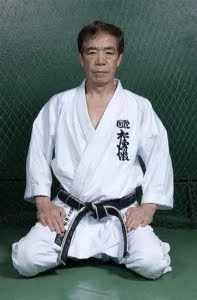
Jiin is another of the 'temple' forms (along with Jion and Jitte) and its name means 'temple ground'. As with the others in the series, the pattern opens with with left hand placed over the clenched right fist, making it a member of the Tomari te school with origins almost certainly in China. Unlike Jion and Jitte however, this kata entered the Shotokan syllabus at a later date. In Funakoshi's master text Karate Do Kyohan there is no mention of this kata. When it was taught Funakoshi tried to change the name to Shokyo but it didn't stick.
Like many of the Shotokan forms this varies from the original as taught on Okinawa and movements at the end of this kata are missing as compared to the purer Shorin ryu version. In the original there is an upward block / lunge punch combination executed first to the practitioner's left and then repeated again 180 degrees to his right.
Kanku Daiis yet another one that Funakoshi sensei changed the name of when he brought karate to mainland Japan. On Okinawa the form was known as Kusanku or Kwanku and was believed to refer to the name of the Chinese martial artist who first taught it. It is believed that the pattern was passed down from the man Kusanku to 'Tode' Sakugawa, then from 'Bushi' Matsumura to Itosu sensei from whom Funakoshi sensei learned it.
Popular opinion holds that the five Pinan / Heian kata were developed by Itosu sensei on Okinawa to include key movements from Kusanku (perhaps along with the two 'lost' Channan forms) interspersed with more basic techniques to make teaching easier to larger and younger classes. Master Kousaku Yokota (Shotokan Karate Myths) suggests that Heian Nidan is a simplified version of this kata in its entirety. Consider also that Shotokan's Heian Nidan is still taught as Pinan Shodan on Okinawa, or the first form learned perhaps betraying the importance of Kushanku on its development and the key role this latter pattern plays in the Itosu system.
Author Nathan Johnson offers a very different idea in his book The Great Karate Myth when he argues that originally this kata was meant to be performed with a pair of sai. In particular, the 'knife hand block' is interpreted by Johnson to be a block with a sai. In the Okinawan version this move is performed in cat stance which, Johnson again argues, allows a swift front kick to kick away the weapon trapped in the prong of the sai or to kick the weapon wielding hand. As with his theories on the Tekki kata however, he offers no direct evidence for his hypothesis.
Johnson also notes that we do not in fact know if 'To te' Sakugawa learned Kusanku 'as is' or if his version is a synthesis of something (or various things) he was taught.
The name of the kata means 'To look to the sky', a reference to the simple but compelling opening movements of the form as the arms are slowly raised with a small triangle formed between the hands.
Bassai Dai has a long history that is currently believed to stretch back some 400 years. On Okinawa the variations are called Passai. Funakoshi sensei made the name change when he brought karate to mainland Japan. It can be understood to mean 'To extract from a castle' or 'To remove an obstruction'. This refers it seems more to the spirit that should be displayed when performing the form rather than giving a clue as to the origins of the movements.
The pattern appears to have come to Funakoshi via 'Bushi' Matsumura to Kokan Oyadomari and then to 'Anko' Itosu, one of Funakoshi's primary teachers. All of these instructors created their own versions and how much the form resembles its original form is impossible to say. Different 'streams' of the kata continue to exist and have always done so. One movement that has remained is the opening stance where the left hand is placed over the right closed fist - indicating its Chinese origin. The form may have originated from Leopard and / or Lion boxing or possible Five Element Fist. There is no conclusive evidence available.
The Matsumura version shows the Chinese influence while the Oyadomari version has been altered, and this variation was in turn changed by Itosu and Funakoshi. It was Itosu who is believed to have created the 'sho' variation and Funakoshi taught both the 'dai' and the 'sho' version on mainland Japan. There are differences in performance between the Shotokan, Wado ryu and Shito ryu versions found on mainland Japan but when comparing the newer Japanese versions to the older Okinawan kata there are numerous differences, though the basic pattern of movement can be discerned.
Tekki Sandan is the third in the Tekki series (see also Shodan and Nidan). While most, if not all, Shotokan dojo teach this kata as a ballistic one using strikes and blocks, Nathan Johnson, in keeping with his theory that the Tekki series in their original form were a catalog of wrist grip escapes and reversals, draws attention to the use of the Naifuanchin Fist Clench in three of his books (Zen Shaolin Karate, Barefoot Zen and The Great Karate Myth). This is a fist used in Chinese kung fu styles and is still seen today in some schools of Okinawan Shorin ryu. The fist is clenched with the bottom three fingers in the normal manner. The forefinger however is flattened out with the tip approaching the thumb joint and the thumb itself wrapping over the forefinger as normal. According to Johnson this grip was used to train and strengthen the hand for grappling. This fist can be seen on page 17 of Karate Do Kyohan by Funakoshi Gichin. However, Funakoshi sensei does not note that the fist is used to practice developing a strong grip and the accompanying application is for a hammer fist strike.
Tekki Nidan is the second in a series of kata (the others being Shodan and Sandan) that was once the backbone of the Shuri te school of karate from which Shotokan emerged.
Though the Tekki kata are now split into three and performed separately, author Nathan Johnson has argued that the three forms should be linked together in one unbroken pattern. The ending of Shodan and the beginning of Nidan, as well as the end of Nidan and start of Sandan, are therefore 'false' beginnings and endings.
Tekki Shodan, the first of the Tekki series of kata (Shodan, Nidan, Sandan), was initially the 'introductory' form for many practitioners of the Shorei stream of karate on Okinawa. Certainly Funakoshi sensei learned this kata (and Nidan and Sandan) first but they were later replaced in the Shotokan syllabus by the easier Heian series of kata and the Tekki forms thus became pre-intermediate level patterns.
The Tekki kata (also known as Naihanchi) are at first glance perplexing when compared to the other forms popular on Okinawa which cover a comparatively wider area with more complicated footwork and stance shifts. The Tekki series require the practitioner to simply move from left to right and appear to only deal with an opponent attacking from the front. The most credible history is that 'Bushi' Matsumura created the first kata and Itosu added the second and third variations. Most likely the original form originated from Fuzhou, China.
Author Nathan Johnson has suggested that the original techniques (not necessarily the form) could date as far back as the Chou dynasty (1122 - 221 BCE) based on a highly suggestive bronze statue from that period that shows two wrestlers engaged in stand-up grappling. The same author has some very unique and original ideas on the application of this kata and maintains that the movements are a catalog of escapes and reversals from a cross-handed grip and that these movements are best applied and 'witnessed' through Chinese pushing hands practice. This is part of a wider point that he has tried to make in the past that karate was originally intended to be a grappling / pushing hands combat system. The shift to a striking / ballistic combat system, he argues, has led to changes in the kata that now make it incomprehensible. For example, Johnson argues that the kicks / knee raises we see nowadays are not to be understood as leg techniques, but necessary counter-balancing movements while performing stand up wrestling. He also argues that the three forms were originally joined together and were not intended to be performed separately.
Funakoshi changed the name from Naihanchi to Tekki while also making the stance deeper and wider from the more upright and natural Naihanchi dachi and Hachi ji dachi. The Tekki kata series may also be known as Naifuanchin.
I am also adding a vintage video of Funakoshi sensei performing Tekki Shodan in 1924. Already you can see the deeper stances, but looking at Kanazawa sensei you can also see that other changes had not yet been implemented.
Heian Godan is fifth form in the series continues to promote an awareness of and successful execution of slow, drawn out movements contrasted with faster, more powerful techniques. This kata is the first to introduce a jump. Harry Cook has noted that the jumps may occur to train the practitioner to develop the springiness and leg strength needed to execute throws and in this pattern it would seem that the technique prior to the jump is indeed a throw. However, as noted with Heian Yondan, others have argued that slower movements in kata could indicate a throw or a lock. The movement before the jump in this form, if it is a throw, is not done in a slow and deliberate manner.
The Shotokan version makes use of the back stance whereas the Pinan original uses a cat stance. The Shotokan version also includes crescent kicks and has placed the final movements directly along the embusen (the pattern of lines the kata 'draws' on the ground by shifting from movement to movement and stance to stance) rather than at an angle.
For more background information on the Heian kata please refer to Heian Shodan.
Despite being considered one of the 'basic' Shotokan kata Heian Yondan introduces new challenges to the practitioner. The form cannot be blasted through and for the first time slowed down movements appear which lead to the development of greater poise and a clearer distinction between explosiveness and softer, slower motions. It is at this point that kata practice begins to look more like it will at higher belt levels. This pattern is therefore a great one for experienced karateka to return to and delve into once more.
I have heard (very) senior Western karate masters argue that movements that are performed slowly in kata can or should be understood as throws or locks. This may or may not be true (the same masters can demonstrate these kata movements as throwing bunkai) but it should be noted that in the Wado ryu and Shito ryu versions of Pinan Yondan (which are much closer to the original) there are no overly slow movements.
For more background information on the Heian series of kata refer to Heian Shodan.
For more information on Heian Sandan and the Heian series of kata please refer to Heian Shodan. This kata appears to have remained fairly close to the original though makes use of the back stance (kokutsu dachi) over the cat stance (neko ashi dachi). The Shotokan version has also added three stomping attacks, supposedly designed to attack an opponent's thigh or knee, that are missing in the original. The form introduces moves and concepts useful for close quarters combat, particularly for dealing with grabs.
Heian Shodan is the first of five Heian kata that were originally created by the Okinawan karate master Yasutsune 'Ankoh' Itosu to be taught to Okinawan school children as part of their physical education. The forms were termed pinan and originally the order of the first two kata of the series were reversed as compared to the order taught by Gichin Funakoshi (that is, Pinan Shodan is Heian Nidan in the Shotokan syllabus and this kata was Pinan Nidan originally).
Heian Shodan and the Channan kata
Typically the Pinan / Heian kata are believed to have had their core techniques drawn from the more advanced (and more challenging) Kusanku / Kanku Dai and Gojushiho kata (Dai and Sho). In recent years this has been challenged by some authors who argue that the origins of the Pinan / Heian kata can be traced back to two Chinese forms known in Okinawa as Channan Dai and Channan Sho.
After Funakoshi sensei brought karate to mainland Japan he made numerous changes, one of which was the reordering of the first two Pinan / Heian kata, as well as renaming the set of five forms. Heian is said to mean 'peace', thereby signifying that through the study of the kata and the subsequent improvement in one's fighting ability, the practitioner can live a peaceful life free from the fear of physical attack. I would also point out however that the Heian period in Japan (794 - 1185 CE) was famous for the practice of modifying and naturalizing Chinese cultural forms that had earlier arrived in Japan. For example, the hiragana writing system which simplifies Chinese characters finally came into existence early in the Heian period. When Funakoshi changed the name of the set of kata from Pinan to Heian karate itself was also undergoing major changes as it was modified from being a Chinese martial art to be more comparable to Japanese martial arts and therefore more acceptable to the Japanese people.
The Empty Mind aims to communicate the spirit and philosophy or martial arts. Contrary to what the title suggests - that the DVD is focused on the experience of mushin (the empty mind) in martial arts - the documentary covers a variety of styles, approaches to training and philosophies. It is very good and very worthwhile watching even if it barely dwells on the experience of mushin.
Principally the DVD interviews a variety of martial arts masters from Chinese and Japanese disciplines and combines these 'words from the wise' with well-shot, professional footage. Personally I found the insight provided by Moriteru Ueshiba (Aikido) to be the most thought-provoking but also of particular interest was seeing how Westerners trained in Chinese WuShu in government-sponsored schools in Beijing. The performances filmed at the Shaolin Temple (Kung Fu) and the Purple Cloud Temple (T'ai Chi) are both amazing and inspiring.
The video clips are not the full versions and what you get on each art on the actual DVD are more extensive.
Kung Fu at the Shaolin Temple
The Empty Mind starts with the first full section on kung fu at the Shaolin Temple. This section introduces Master De Ru, a monk who taught in the US and who therefore speaks (very good) English and Grand Master Shi De Yang, both of whom have a welcome sense of humor. The Shaolin Temple is touted as being the birthplace of East Asian unarmed martial arts as we know them today (covering China, Japan and Korea) as well as being the place where a synthesis of Indian Buddhism and Chinese Taoism took place to produce Ch'an Buddhism, which is better known by its Japanese name of Zen. Master De Ru gives a good overview of the relationship between kung fu and Ch'an / Zen and this section comes the closest to living up to the title of the DVD: The Empty Mind.
Monk De Ru explains in The Empty Mind that emptiness is the origin of both the universe and the person. When we can reconnect to this vast 'nothingness' we understand that we are not separate from anything. The body is a vehicle to help us experience the single energy that permeates all things. Through the study of kung fu, or traditional wushu as Grandmaster De Yang calls it, the mind and body are unified and we understand ourselves as a microcosm of the universe.
In the DVD you can see senior students at the Shaolin Temple perform various techniques, including weapons drills at full speed, weapons practice while blindfolded and the 'Iron Body'. Also very impressive are the very young, but very serious and very talented, kids at the temple.
Tai Chi at Purple Cloud Temple, Wudang Mountain
Tai Chi is based on the effortless of nature. The student follows the path of least resistance, as water streams down from a mountain top. The matter is not forced; rather we yield to physical matter. This is known as wu wei, an important philosophy in both Taoism and Tai Chi. Tai Chi is considered to be a 'soft' or 'internal' martial art when compared to Shaolin kung fu, which is often described as being 'hard' or 'external'.
Priest Yuen and Priest Bing introduce the viewer to the Tai Chi at Purple Cloud Temple, the oldest and most reputable school on Wudang Mountain. The priests - through the narrator - explain that a fundamental belief of Taoism is that when we are born, we are born in balance but we lose this balance as we age through the influence of external factors. All things change, but this balance can be restored through correct training with an emphasis on balance, posture, and flexibility.
Contrary to popular images of Tai Chi being 'easy' practice is in fact demanding. While one muscle is relaxed, this is balanced out by another being in a state of tension, thereby symbolizing the interaction of yin and yang. The same shifts between tension and relaxation are also found in the breathing pattern, which is meditative in nature (while also promoting health). Breathing is itself regarded as being important as when co-ordinated correctly with the movements of the body chi is produced. Chi is described as being an energy that is both within and without. It is developed within through correct posture and breathing. (Click here for some deep breathing exercises that I have developed and use).
The priests at the Purple Cloud Temple explain in The Empty Mind that students arise at 5 am and practice for around 8 hours a day. The skills - and, like the Shaolin monks - the flexibility of the students are amazing. Most of the footage focuses on form practice. Here the flow of movement is mesmerizing and it is relaxing simply to watch the performance.
Wu Shu and Kung Fu in Beijing
China has a turbulent history that culminated in the seizure of power by Mao Tse Tung. Mao was the last in a long line of rulers that oppressed traditional martial arts, the masters and the schools where the arts were taught. Fearful that the masters may have provided a rallying point for disenchanted youths as well as training in combative methods - as had been witnessed in the disastrous Boxer Rebellion - Mao purged the arts and those connected with them. In turn a method of state-sponsored (and approved) wu shu has arisen that has spread throughout China.
This segment of The Empty Mind examines the state of martial arts in Beijing, the capital of China. The documentary first takes a look behind the doors of the Capital College, where China produces its Olympic gymnasts, where modern wu shu is taught and practiced.
Sifu Zhao Ping, a former national champion, teaches a foreign student class at the Capital College. Gaining a glimpse of this training was extremely interesting for me as it is so different from more traditional forms of development that promote physical and mental conditioning as well as aesthetic skill. However, the Capital College makes only a brief appearance.
The Empty Mind next moves onto informal kung fu training in the parks of Beijing. One of the most amazing images presented here is of Master Zhang Sheng Li practicing with a broadsword...and no one cares! I can't imagine anyone getting away with this in a Western country or here in Japan.
The second thing that amazed me is how, one by one, top masters casually turned up to participate in the practice from all kinds of different styles. We can therefore see a variety of different Tai Chi styles demonstrated.
The third thing to amaze me - as The Empty Mind shifts to Shanghai - is the commitment the older generation shows to their health and fitness by utilizing training equipment provided for them in the parks. While much of the exercises will be recognizable, one that remains curiously Chinese is chi gung, which is a method of developing one's chi, or 'life energy'. One guy there, at the age of 82, is anything but his age. He is vibrant, alert and clearly in (very) good health.
This section of The Empty Mindis, shall we say, quietly interesting. It lacks the dynamism and history of the sections on Shaolin and Wudang but is captivating as it manages to capture the role kung fu plays in the lives of the average Chinese person.
Kyudo - The Way of the Bow
Almost the entire sequence found on the DVD can be viewed in the YouTube clip above. Preceding the main part is a video of a traditional (and very colorful!) procession at a Shinto shrine. This is not connected directly to kyudo and only sets the scene for the religious elements seen in the clip above.
The Empty Mind maintains its excellent access to the top people of the respective martial arts covered and here presents the highest ranking members of the All Nippon Kyudo Federation. Attention is drawn to the Shinto and Zen Buddhist aspects of the art and it was this art that first drew the attention of Westerners to the similar purposes of Zen and the Japanese ways through the publication of Herrigel's Zen and the Art of Archery.
The aim promulgated by kyudo masters and discussed in The Empty Mind is that the art is less about hitting the target and more about hitting your self. It is a way of penetrating into your own psyche (I would argue into an experience of increasing right brain hemisphere dominance). Note as well when watching the video the emphasis that is placed on posture and correct breathing. These facilitate the meditative process.
Japan Karate Association
For this section of The Empty Mind there is no YouTube clip available. The DVD visits the JKA Headquarters in Tokyo and looks in on a famous Instructor's Training session. Masahiko Tanaka is (kind of) the focus of this segment but - disappointingly - he is not interviewed and we see only very little technique from him. The other instructors are of course all top notch and the DVD shows them performing basics, sparring drills and Bassai Dai in a group. This segment gave me the impression that it was more a way to introduce karate to the viewer and I would have liked to have seen more on the JKA.
Master Hirokazu Kanazawa
One of the highlights for me was this interview with Kanazawa sensei. Filmed when the master was 72 we get to see the great man in action and listen to his words of wisdom on the Way.
Kanazawa Sensei talks about the pursuit of success and the need to remain humble in the pursuit of it. Here he talks about mushin (the empty mind), defining it as a state of total control and concentration. This is the same mind that is needed to find success in your life. He also talks about using our 'spiritual energy' or ki to drive us forward spiritually.
(I would add that research into the way mushin is understood and used is of great interest to me and I again note - for regular readers who are following my thoughts - that Kanazawa sensei is here using a definition of the term that contradicts its literal meaning. He is talking about intense concentration and total control. This is at variance with the notion that mushin means no conscious mind or the empty mind and it is, I would argue, zanshin that is being described here).