Showing posts with label kanryo higaonna. Show all posts

Tuesday, May 10, 2016

The History of Karate by Morio Higaonna

The History of Karate by Morio Higaonna - Book Review covering the history of Naha te / Goju ryu and the life of Chojun Miyagi. Although this book is now somewhat old, I recently got a copy of it from a friend and decided to review it based on the strength of the material presented. That said, the first important thing to note is that the title of the book is somewhat deceptive. The sub-title is 'Okinawan Goju Ryu' and that is precisely what is covered in the book. It is less 'The History of Karate' and far more 'The History of Goju Ryu Karate'. That shouldn't dissuade anyone interested in the history of karate or the Okinawan arts in general from reading it, but the book will be far more appealing to Goju ryu practitioners than anyone else.

The contents of the book are a blend of historical facts and collected anecdotes. The facts are far more appealing than the anecdotes as the latter can be somewhat vague in painting an accurate picture and at least one story is clearly made up and this unfortunately casts a shadow of doubt over the rest of the anecdotal evidence. The story in question relates to Chojun Miyagi and the claim that one night during the Battle of Okinawa he was strafed by a single US fighter plane but managed to escape any harm by running in a zig-zag pattern. I would be dubious about the story even if it was claimed to have happened during the day, but the fact that a carrier-based plane was flying around at night is clearly rubbish. I appreciate that in East Asia in particular great reverence is given to elders and teachers and former students are no doubt well-meaning in attempting to portray their sensei as being the bees knees, but it makes it difficult sometimes to distinguish between what is fact and what is not.
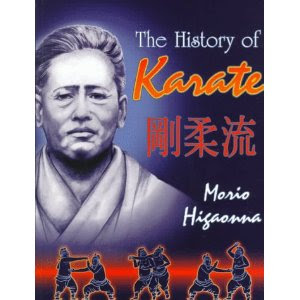
Morio Higaonna has done a great job of presenting the information and where he is lacking in conclusive proof he is happy to present all theories. One such instance is his frank admittance that, after research in Fuzhou prefecture, it is impossible to determine which Chinese kung fu / wushu style in particular Goju ryu is descended from.

The History of Karate briefly covers the historical background that led to the formation of various karate styles (most notably the military dominance of Okinawa by the Shimazu clan from 1609 onwards) and then jumps into the Goju ryu history proper with Kanryo Higaonna's trip to Fuzhou to train with Ryu Ryu Ko. Kanryo Higaonna (no relation to the author and famed karate master Morio Higaonna) returned to Okinawa and began teaching. One student in particular stood out, Chojun Miyagi.

Much of the book is devoted to the life of Chojun Miyagi and how he formalized and spread what developed from Naha te and came to be known as Goju ryu karate around Okinawa and finally to mainland Japan. A lot of great, insightful information is presented though as mentioned above, I recommend treating at last some of it with a degree of skepticism. There are some gems though, such as details on Chojun Miyagi's trip to Hawaii and his discovery and adoption of the kongo ken training device.

The book also covers the lives of Jin'an Shinzato (Miyagi's top student before Shinzato's death during the Battle of Okinawa) and An'ichi Miyagi (a primary teacher of Morio Higaonna).

This brings me to the most glaring omission in The History of Karate. After the death of Chojun Miyagi in 1953 it was Ei'ichi Miyazato, Miyagi's most senior post-war student, who established the Jundokan dojo in Okinawa to continue the teaching of Goju ryu. Despite this Morio Higaonna barely mentions Miyazato and there is certainly no focus given to this late master aside from a short interview at the back of the book. To be fair to Higaonna, Miyazato admitted in an interview that he had been approached to participate in the book, but still I feel a lot more could have been done to detail the life of head of the Jundokan. Afterall, a tremendous amount of information was presented on Miyagi, Kanryo Higaonna and even Ryu Ryu Ko without interview access. Without going into the politics of it all it seems that Morio Higaonna championed the idea that An'ichi Miyagi - Higaonna's principle teacher through much of his life - was the true inheritor of the legacy left by Chojun Miyagi. Unfortunately this is reflected in the book and to an extent it does read as if Morio Higaonna is attempting to legitimize any claim he may make as being the next in line of direct succession from Ryu Ryu Ko to Kanryo Higaonna to Chojun Miyagi to An'ichi Miyagi and then to the author. In this respect, the latter history of more modern Goju ryu does not appear to be being presented as objectively as the earlier history.

The History of Karate: Conclusion

All said though, The History of Karate is a great read and well worth delving into. Various other karate masters are mentioned to a greater or lesser extent and anyone with an interest in the overall shift from karate as a fighting art taught to select students to a more popularized version will find this book of value. Needless to say, for Goju ryu trainees, this should still be considered essential reading despite some bias in the presentation of evidence and opinion.

Monday, May 9, 2016

Goju Ryu Karate

Goju ryu karate plays an important and significant role in the long history of Okinawan fighting arts, going back centuries if one traces the origins back through Chinese and Japanese sources. Goju ryu itself however, at least as a discernible style, has a more recent history. The art originated with Kanryo Higashionna, a former student of Shuri te Master Aragaki, who traveled to Fukien province in the second half of the nineteenth century and studied under Ryu Ryu Ko. Ryu Ryu Ko seems to have been Xie Zhongxiang, the founder of Whooping Crane kung fu, though this is by no means certain. After returning to Okinawa Higashionna began teaching his version of Naha te.

Chojun Miyagi and the Creation of Goju Ryu Karate

His most promising student came to be Chojun Miyagi. Miyagi studied with Higashionna for the last fifteen years of the masters life, interrupted by a one year visit to Fukien in search of the origins of Naha te. Unable to find a suitable teacher Miyagi instead studied under various people and returned to Okinawa with a new kata that he named Tensho, a variation on the White Crane Rokusho. Tensho is considered to represent the 'soft' side of the art while the signature kata Sanchin represents the 'hard' side. This exploration of hard and soft is reflected in the name Goju, which means Hard / Soft. Goju ryu karate therefore means the School or Hard and Soft Karate. The term itself was taken from the Bubishi, a collection of articles on Southern Chinese fighting arts (among other things) that influenced Okinawan karate. In its day this was the closest thing to a manual that existed and it continues to be studied today.

The style draws its core techniques from twelve kata, with Sanchin being the most important and heavily practiced. Stylists also continue to emphasize conditioning the body and use the makiwara (striking post) as well as traditional Okinawa weight training equipment (known collectively as hojo undo) supplemented by the kongo ken which was introduced after Master Miyagi saw wrestlers on Hawaii using something similar. Foju ryu also makes use of kakie, or pushing hands, inherited from China and nowadays somewhat lacking in karate which tends to favor longer distance sparring. The style is most effective at close quarters, though it does lack ground work.

Since the death of Chojun Miyagi, the style has become somewhat splintered. Jinan Shinzato, Miyagi's top student, was killed during World War Two. Ei'ichi Miyazato was elected to formally take over the style as its overall master but Meitoku Yagi had inherited the master's gi and belt, factors which carried significance. Furthermore, the only person Miyagi actually authorized to teach was Seiko Higa. It seems that there is no clear lineage for a student to follow any longer. Arguably the most famous Goju ryu karate master alive today is Morio Higaonna, who remains hugely popular with an international student body.

Wednesday, May 4, 2016

Goju Ryu Karate Kata

Goju ryu karate kata traces their roots back to pre-twentieth century Okinawa and before that to Fuzhou in Fujian Province, Southern China. According to the accepted history, Kanryo Higaonna left Okinawa for Fuzhou sometime in the second half of the nineteenth century (precise dates vary, from 1867 to 1877). In Fuzhou Higaonna is reported to have become the live-in disciple of a Chinese Whooping Crane master named Ryu Ryu Ko. Upon Higaonna's return to Okinawa he passed on his teaching to Chojun Miyagi, the man who coined the term Goju to describe the style that was formerly identified simply as Naha te owing to the location in Okinawa that it was taught and practiced.

The kata of Goju ryu karate are very different from the Shuri te branch that provided the base forms for Shotokan. Unlike the Shotokan patterns of which many were altered first by Master Itosu and then later again by Master Funakoshi on mainland Japan, the Goju ryu forms are not known to have been changed, except for the practice of Sanchin being altered from using an open 'spear' hand to a closed fist punch.

Are all Goju Ryu Karate Kata from China?

However, there is an emerging debate as to whether nor not the bulk of Goju ryu karate kata are in fact originally from China in the first place. Exactly who Ryu Ryu Ko was is currently unknown and Morio Higaonna admits in his book The History of Karate that the style of Chinese kung fu that Goju ryu is supposedly derived from cannot be determined. Sanchin kata is the only form on the list with clear roots in Southern China and it is a staple of numerous kung fu styles. The Gekisai Dai Ichi and Gekisai Dai Ni patterns are definitely later additions created and introduced in 1940 by Master Miyagi and Tensho seems to be derived from Rokusho. Author Nathan Johnson concludes in his book The Great Karate Myth that the rest of the Goju ryu karate kata were in fact created by Master Miyagi on Okinawa in the first half of the twentieth century. I discuss the possible origins of each form individually so please follow the links below to learn more.

Whether of Chinese origin or not, the kata found in Goju ryu are powerful and combine linear and circular movement to fight at close-quarters using punches, kicks, elbow and knee strikes as well as locks, takedowns and throws. Central to the study of the kata and Goju ryu in general is Sanchin and this 'hard' form is tempered by the softer approach taken in Tensho - the hard (go) and soft (ju) of Goju ryu.

The following kata are demonstrated by Master Morio Higaonna, arguably the most famous Goju ryu karateka alive today. While no relation to Kanryo Higaonna, Master Higaonna trained with Chojun Miyagi and then Eiichi Miyazato and Anichi Miyagi, two of Master Miyagi's top students. At the time of writing (2015) he currently teaches in Okinawa.

Gekisai Dai Ichi
Gekisai Dai Ni
Saifa
Seiunchin
Shisochin
Sanseru
Sepai
Kururunfa
Seisan
Suparinpei
Tensho
Sanchin

Tuesday, May 3, 2016

Saifa

Saifa is the first classical kata of Goju ryu karate. The first two kata studied (Gekisai Dai Ichi and Gekisai Dai Ni) were created by Goju founder Chojun Miyagi in 1940. The name of the kata means 'smash and tear' and it teaches techniques and concepts related to close quarters combat.

Traditionally it is thought that this kata was learned by Kanryo Higaonna from his teacher Ryu Ryu Ko while the former studied in China in the second half of the nineteenth century. This is the argument presented by Morio Higaonna in his book The History of Karate. At that time however 'things Chinese' carried with them a greater sense of value to Okinawan people and it may have been the case that this kata did not come directly from China but was only said to have done so. Or, that it was introduced from China at a later date by Chojun Miyagi and was not part of the original syllabus. Another idea is that Master Miyagi created the kata himself from his own insight and influenced by other forms.

Recent research has begun to suggest that Kanryo Higaonna may only have learned Sanchin, Sanseiru, Seisan and Suparinpei. Nathan Johnson in his book The Great Karate Myth examines this issue in more detail.

The origins of the form are further muddied by the lack of a reliable insight into the kung fu style it originated from. Accepted versions hold that it is from a Tiger or Crane style, but one researcher has put forward the argument that it may be derived from Lion kung fu.

The techniques in the kata teach the practitioner Folding, Grounding and Whipping. Folding refers to the practice of collapsing an opponent's limb at the joints, allowing it to be controlled. Grounding is the ability to 'sink into the floor' and then rebound up to generate more power. Whipping is the ability to deliver fast attacks with a whip-like motion. In addition, Gavin Mulholland argues in Four Shades of Black that this form is about learning how to break free of all manner of grabs and holds.

Master Morio Higaonna performing Saifa